Hi,
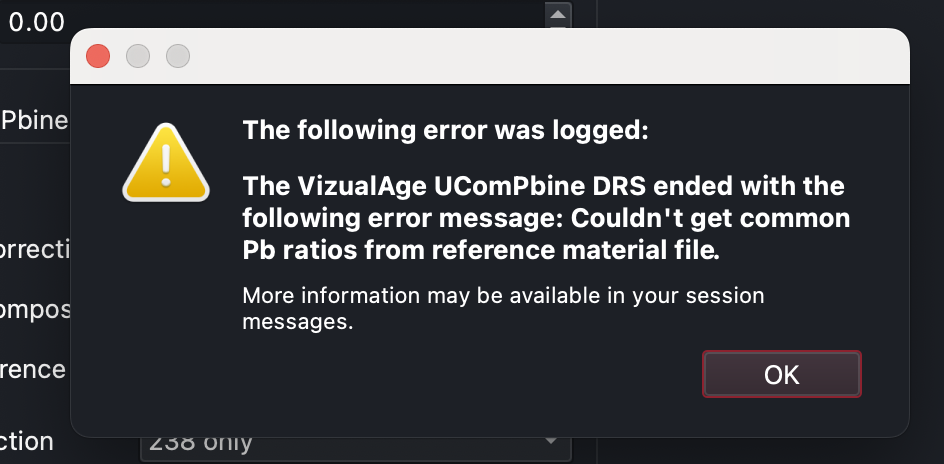
I have encountered an interesting problem with this DRS.
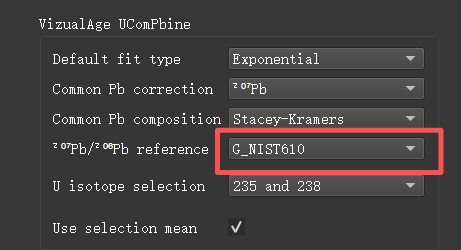
I am processing an allanite U–Th–Pb dataset. One of the NIST610 analyses shows an anomalously low raw 207 Pb CPS. When I select NIST610 as the 207Pb/206Pb reference (see the attached figure), some unknown analyses located close in time to this anomalous NIST610 analysis show 207Pb_CPS intermediate values that are even higher than the raw 207Pb input values.
At first, this seemed to imply an abnormal baseline correction. However, I checked the baseline spline, and it is around 53 CPS, which is a normal positive value.
I then excluded this anomalous NIST610 analysis from the NIST610 group and reran the DRS. After doing so, both the 207Pb_CPS intermediate values and the final 207Pb/206Pb ratios of the affected unknowns became normal. The results are also normal if I select “None” instead of NIST610 for the “207Pb/206Pb reference”.
This makes me wonder whether the “207Pb/206Pb reference” correction is applied across the whole session, including both the primary reference material and the unknowns, and whether the 207Pb_CPS intermediate channel is therefore not simply a baseline-subtracted signal, but has also been modified by the NIST610-based Pb/Pb instrumental correction.
If so, could you please explain how this correction is implemented? In particular, I would be very grateful if you could provide the relevant equations or describe how the NIST610 correction factor is propagated through the dataset.
I hope I have explained the problem clearly. I have spent several days trying to understand this behavior.
Best regards,
Kai