Hi @Chiranjeeb,
1/ If you don't have a near-constant 7/6 RM, it's better to use the 'None' option. The 207Pb/206Pb reference is to do a mass bias correction, and if 7/6 is not constant within your primary RM, the mass bias correction will actually add noise to your Final 7/6 ratios (hence it being better to use None than your primary).
2/ The 'Use selection mean' option allows you to use the average of the entire selection for the common Pb correction of the primary RM. You would only use this if you expect your primary RM to have a constant common Pb fraction, like this:
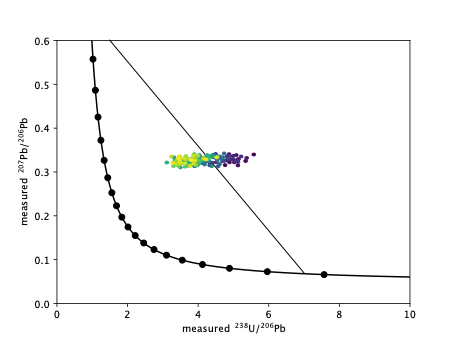
This might provide additional precision for the common Pb correction of your RM, but only if it looks like the above. Something like perovskite might be suitable for this approach, whereas apatite RMs commonly have variable amounts of common Pb within each analysis, and using this approach would give you nonsensical results, which would be visible in your DHF fit plots (obviously it depends on which primary RM you're using). This is only used for the common Pb correction to determine the downhole fractionation trend in your primary RM, not for the Final ratios.
3/ This is just a product of the non-sensical results for common Pb correction using the selection mean I mentioned above.
If you use "Factor" or "None" no error propagation will be applied to the 7/6 ratios. This is because there will be no RM to use in the jack-knife/MSWD approach.
Also, just to include it here: the factor approach allows you to input a mass bias factor to apply to your raw 7/6 ratios. Normally you would know this from some constant 7/6 RM measured at the same time, or from previous experiments (some ballpark figure). Given that mass bias on the 7/6 ratio is likely to be much smaller than U-Pb inter-element fractionation, this correction is likely to be much smaller than the DHF or Final bias correction.
Note that the final bias correction corrects for mass bias in the 7/6 ratio, but this happens after the DHF correction. Given that we're applying a common-Pb correction that may rely on the 7/6 ratio, this is where the 7/6 correction could improve results: applying a better 207Pb correction for the DHF correction.
So, to summarize, if you don't have a constant 7/6 RM (e.g. a NIST glass) in your analysis, I would opt for "None" or put in an approximate mass bias correction. Most of the time bias in the 7/6 ratio will only have a small effect on the common Pb correction (or none, depending on the 'Common Pb correction' chosen).
I hope that helps. Please let me know if you have any questions.
Kind regards,
Bence


